Make local processing understandable and dependable
Many image utilities send every selected file to a remote processing service. Ziply takes a different approach: its supplied compressor decodes and encodes supported still images in the browser using a Worker, Rust/Wasm artifacts, and available browser codecs.
The goal is not to attach an unlimited privacy claim to a web page. It is to maintain a specific, testable boundary: selected image content does not enter the Ziply API, and the backend does not expose an image-upload or remote-transcoding route.
Private image compression in your browser
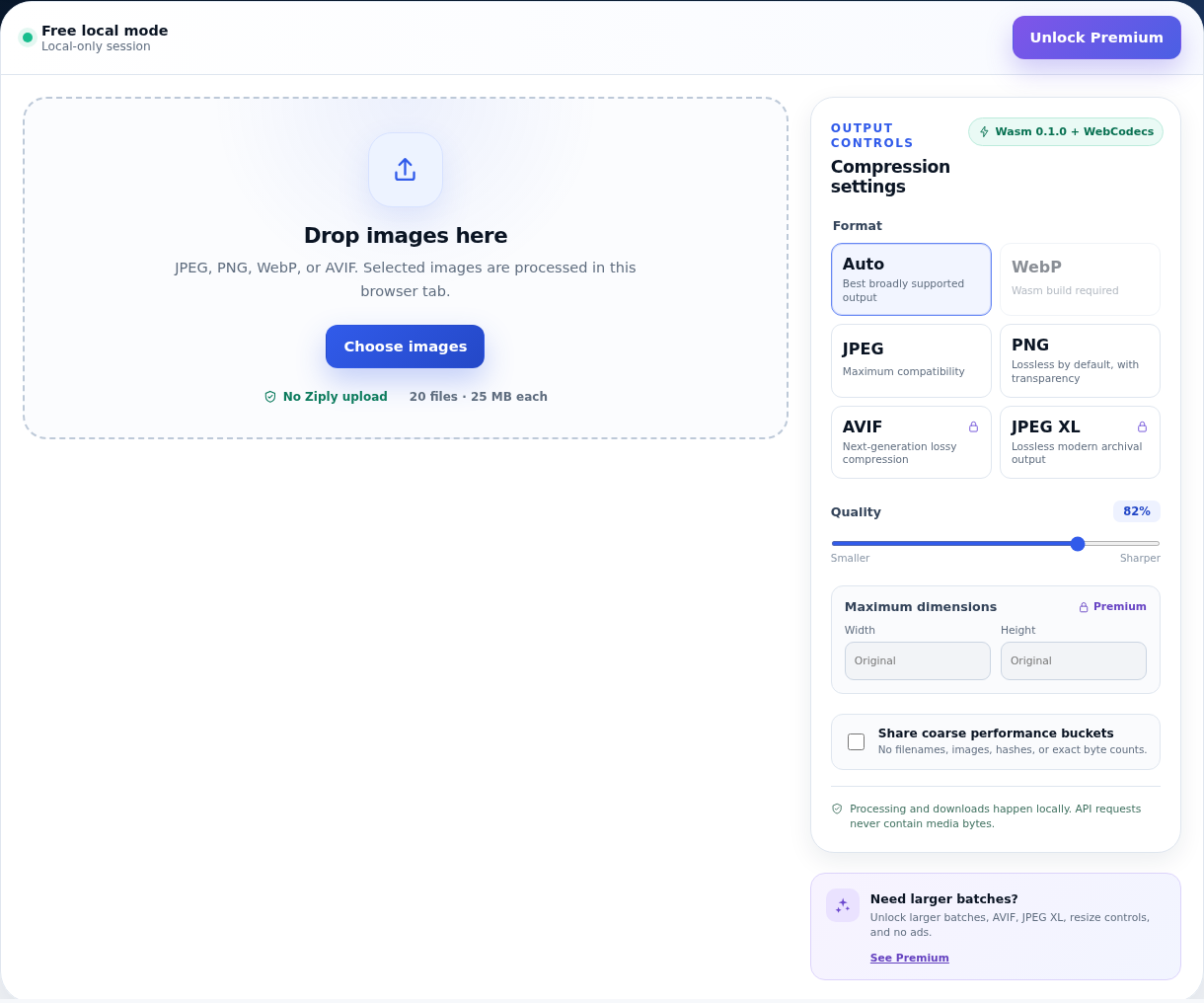
Ziply puts format selection, quality controls, and browser-engine status beside the local file picker so the processing boundary remains visible while you work.
How we make product decisions
Keep media local
New features must preserve the browser-side media path or clearly disclose a different architecture before they ship.
Fail visibly
Unsupported animation, unavailable encoders, and account uncertainty should stop or remain locked instead of silently weakening the result.
Earn the download
An optimization should improve the practical delivery file. The original remains untouched so the user can reject the result.
Free utility, Premium subscription, limited editorial advertising
Free image processing is intentionally useful. Premium funds advanced local encoders, larger browser-bounded batches, resizing controls, and an ad-free Ziply experience. The Free homepage includes a prominent sponsor placement, and manually placed Adsterra display banners can also load on substantive Learn articles after a visitor allows them. Account, pricing, legal, contact, and company pages remain free of third-party ad units.
Editorial recommendations are written independently of advertising. Automatic, sticky, social-bar, interstitial, and popunder formats are not part of Ziply’s delivery design.
Compare plansWhat local processing cannot promise
Ziply cannot protect files from a compromised browser, malicious extension, infected operating system, altered deployment, or unrelated software on the device. Codec availability and safe batch capacity can also vary with browser, memory, dimensions, and device performance. The interface detects and communicates those constraints rather than routing around them with a hidden upload.
Read the Privacy notice for data and retention details, the Terms of Use for service conditions, or visit our browser-side compression guide for a plain-language walkthrough of the media path.